

Performance Report: 01/31/2026
All performance data for our strategies is net of all fees and expenses. All performance data for indexes or other securities is from sources we believe to be reliable. All data is as of 01/31/2026
Investment Strategy
MAP - Full ($500k+)
MAP - Plus
MAP - Balanced
S&P 500 Index2
Mod Alloc(AOM)2
Growth Alloc (AOR)2
Jan Return
15.2%
14.9%
5.7%
1.4%
1.5%
2.1%
2025
35.7%
N/A
N/A
16.4%
13.3%
16.4%
Inception1
128.2%
N/A
N/A
135.8%
50.0%
71.4%
Sortino3
1.44
N/A
N/A
0.84
0.57
0.70
(Disclosure: We added performance figures for our new strategies solely on a month-to-month basis as any prior data will be inconsistent and potentially misleading. We will post continuous data for our full-size MAP Strategy since its inception on 5/1/2019. We use AOM and AOR as our benchmarks as they are low-cost index funds that model the exposure of the majority of retail investors. Our risk measures are aligned closely with these funds. It is important to note that individual account performance varies and your account may perform better or worse than its model. The model's performance is simply the average performance of all accounts participating in the model.)
Performance Update
WOW, what in incredible month! Our returns were several multiples of whatever benchmark you want to pick. Since inception, our Full-MAP strategy has delivered 94% of the returns of the S&P 500 at half the risk, as measured by downside deviation. As for the benchmarks that match our risk, the strategy has returned 180% versus the returns of AOR with slightly less risk and 250% of the returns of AOM with slightly more risk (our risk has fallen dead in the middle of AOM and AOR.)
Precious metals were largely responsible for our outperformance but we had nice gains in other areas where most equity indexes were up marginally. I've been anticipating this kind of move in the hard asset space for quite some time. Three years ago, I wrote an investment thesis for my clients which succinctly describes what is currently taking place in the precious metals space:
I believe, based on considerable research and ongoing observation, that the Federal Reserve Board (FED) and its member banks (read: Wall Street) are deliberately suppressing “paper” commodity prices by taking a “naked-short” position in a host of commodity futures contracts. This suppression which started in 2011 has resulted in malinvestment in the physical commodity space which in turn may lead to explosive gains when the physical market for commodities overwhelms the paper market for commodities. If we can get in front of this trade, the gains in our accounts could be one of the more profitable opportunities in our lifetime.
When I wrote my thesis, I didn't know which commodity would move parabolically higher, I just knew there would be a physical shortage in something and when that happened, that specific commodity would go to the moon. And that is precisely what happened to silver over the past 13 months. Silver exploded higher appreciating from $25/ounce to over $100/ounce, a gain of over 300%, in just over one calendar year.
We've been blessed that my MAP system generated buy signals in the precious metals consistently the past 13 months. Last year, we started the year with about a 7% allocation to gold and silver and, throughout the year, our allocation rose as high as 35% (It would have been higher but I capped our exposure at that point). Meanwhile, most other commodities fell victim to the FED's continued suppression scheme and the MAP steered us clear of those.
In addition to the precious metals, we had a few other plays that helped contribute to our healthy gains in January- there were some nice gains in energy and uranium stocks.
I believe it is time to cull some of our investment themes and securities. We've done incredibly well the past 13 months and several of our themes are long-in-the-tooth. Over the next month, I'll be shifting some things around reducing our exposure to the themes we've depended on this past year and adding some new securities. During this time, our exposure may be limited.
Forward Strategy
New Year, new approach to my update. I'm going to replace the "Market Commentary" and focus more on the Firm's "Forward Strategy".
There are several themes that have been on my radar but given how well precious metals and uranuim had been behaving, I didn't want to add more risk and jeopardize our returns. Now that I've liquidated a decent bit of our exposure to these two spaces, I need to find a way to fill in the gaps. Here are the investment themes that I'll be including in my MAP system this year and I'll buy and sell them according to the MAP's signals.
Theme #1 - Gold and silver: I'm not giving up on gold and silver just yet. Currently, my stance is there is a better than 50/50 chance that precious metals will reach new highs in the next 3 months. There are a massive number of paper contracts maturing in March in the PM space. If the holders of these contracts demand physical delivery of gold and/or silver, the gains could be breathtaking. I think the SEC/CBOE/FED will likely step in and create some workaround just as they did when the Hunts cornered the silver market in 1979. But in the interim, the gains could still be substantial.
To add to the bullish case for PMs, the USD has just completed a highly reliable technical pattern called a "Pennant Flag". Here is an image of the chart.
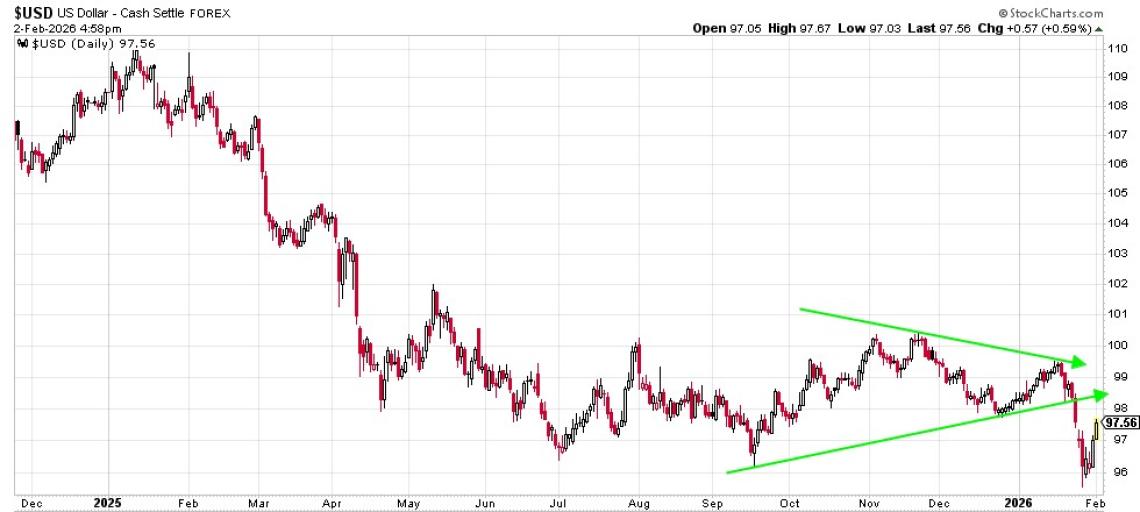
In my experience, the Flag pattern is the most reliable technical pattern there is. Folks talk about "Head and Shoulders" and "Wedge Reversals" but nothing is more straight-foward and reliable as a Flag pattern. The Flag pattern simply illustrates that after a security becomes heavily oversold or overbought, the USD in this instance, fewer investors become interested in the trade continuing. However, there is no reversal because no one is interested in taking the other side of the trade either. Buyers and sellers just take a break waiting to see how it will playout. In this case, the USD bears have all made their money in the trade but there are no USD bulls to reverse the momentum. Thus, once a catalyst arrives to send prices lower, the larger trend continues. A couple weeks ago, the catalyst that sent the USD lower was Trump's new threats on Greenland's sovereignty.
There is a lot of banter among market technicians about what should happen next. Some say the move subsequent to the Flag should be the same size and time duration as the prior move. In this case, about 14% lower and 9+ months long. Others call this move a "Final Flag" and would argue the downtrend will be resolved shortly. Across my four decades of studying this pattern, I can't say anyone really knows. Each subsequent move to a Pennant Flag is its own unique beast. The next move in the USD could be very brief or very long. What we do know is the USD is most likely down for a bit, and thus, precious metals should benefit from any weakness in the USD.
Theme #2 - SOS (Sugar, Orange Juice and Soybeans): My thesis did not single out precious metals. When I wrote it, I truly didn't know which commodity would break free from the shackles of the FED's monetary malfeasance. This past year was silver, this year maybe sugar. Ultimately, there are going to be shortages in all kinds of hard assets. This is nothing new. Every single time the banking cartel tries to push physical prices around using paper markets, it works for a while but then it ends very badly. It happened this way in 1929, 1971, and in 2008. This time will be no different. This is the hand we are dealt and we just need to play it the best we can.
I think the next round of shortages is most likely to happen in commodities that we do not produce for ourselves. Most all our sugar, and some of our soybeans and OJ, are imported from various places in South America. Will Brazil start pricing their agricultural exports in Real and refuse USD's? I think that is all too likely. Maybe not imminent, but it will eventually happen.
A couple of years ago, two major freezes in Florida coupled with ongoing citrus greening led to a shortage situation in OJ. My full-size accounts approved for futures were able to profit handsomely from a 150% price move in OJ. There was a 200% move in wheat when Russia invaded Ukraine. These types of moves will take place across the spectrum of commodities. I don't like it but there is nothing I can do about it- except prepare you for it.
Theme #3 - BRICS dedollarization: The BRIC nations are proactively seeking to replace the USD-backed SWIFT monetary system. The SWIFT system is how the great majority of international transactions are settled between banks. And at this time, 100% of those transactions are settled in USDs. Once the BRICs create a system that is not USD-dependent, then the USD will suffer mightily. For some time, the BRIC nations were stuck on how to create a cross-border, universal currency such as the Euro. But they recently realized that a) the Euro hasn't worked out all that well for Europe and b) there would be no way for a fragmented group of developing economies to settle on a cross-border, universal currency. So, now the BRICS are moving forward with a multi-currency system. It could take shape in a myriad of ways. China has developed its own central bank digital currency (CBDC), the Digital Renminbi. When you buy something from China, you'll need to first convert your USDs to Digital Renminbi. Brazil may back its Real with real, hard assets as the USD was once backed by gold, and is now loosely backed by oil.
This is an inevitability. Within the next 10 years, developing nations will engage in cross-country transactions in local currencies. And this will greatly reduce the demand for USD's. Will this mean the USD loses its status as the world's reserve currency? I think the answer is "probably yes". Will the Petrodollar go away? Again, probably yes.
Theme #4 - Immunotherapy: This will be a minor theme and one we've dipped our toe into the past year. I don't understand all the angles but I have been in discussions about it with several doctors and it is clear that immunotherapy is gaining traction in treating certain kinds of cancer.
Theme #5 - 3-D Printing: This is another minor theme but one that is worth dedicating an allocation towards. As world trade breaks down, 3-D printing could become a means to produce one-off parts that we need. We have had a little exposure to this space over the past year and I expect to add some positions here and there.
Conclusion
The most prominent sign in my HS basketball lockeroom said, "Offense Wins Games, Defense Wins Championships". And I couldn't agree more, both in sports and in investing. There is a time to go on offense and there is a time to be defensive. In my estimation, it is time to be defensive. In this decade, the swift declines in the stock market have all taken place during the Lenten season which is fast approaching. Just like the Santa Claus rally is a time you don't want to "fight the tape", it appears the stock market seems to "run out of gas" right after Christmas. Once year-end rebalancing takes place, the stock market becomes vulnerable.
We're blessed that my MAP system has been successful in providing low-risk entry points and I'll continue to selectively take buy signals when they come up. But I'm going to be very selective in anything that is outside of my major themes. I suspect we'll have very little beta (i.e. broad stock market risk) in our portfolio for the foreseeable future. There is room, from a technical standpoint, for one decent-size rally that may take place in US equities and vault indexes to new all-time highs. And if the S&P 500 breaks out of its current consolidation pattern, I expect I'll add some beta. But any beta I add will have a very tight stop price in place.
Otherwise, I'll stick to the themes I addressed above. I need to do some research on several of them before adding any names to my MAP. I will be working diligently on that over the next few weeks.
As always, please don't hesitate to call us at 512-553-5151 if we can be of any assistance.
Best,
Matt McCracken
1) Inception date of 4/30/2019
2) All benchmark prices and returns are obtained through IBKR's PortfolioAnalyst reporting tool. S&P 500 Index is calculated using the index price. AOM is the iShares Core 40/60 Moderate Allocation ETF. AOR is the iShares Core 60/40 Balanced Allocation ETF. These benchmarks were chosen as they represent the prevailing investment strategies of retail advisors.
3) The Sortino ratio is a commonly used measure of "alpha" or the value a manager adds to a portfolio. It is similar to the Sharpe ratio. The Sortino ratio does emphasize the negative impact of downside volatility more than the Sharpe ratio which is why we use it as our primary measure of alpha.