

Performance Report: 03/31/2026
All performance data for our strategies is net of all fees and expenses. All performance data for indexes or other securities is from sources we believe to be reliable. All data is as of 03/31/2026
Investment Strategy
MAP - Full ($500k+)
MAP - Plus
MAP - Balanced
S&P 500 Index2
Mod Alloc(AOM)2
Growth Alloc (AOR)2
FEB Return
(4.4%)
(7.2%)
(3.2%)
(5.1%)
(3.6%)
(4.5%)
YTD
15.4%
12.5%
5.2%
(5.3%)
(1.1%)
(1.5%)
Inception1
128.7%
N/A
N/A
121.8%
46.7%
66.2%
Sortino3
1.39
N/A
N/A
0.75
0.49
0.62
(Disclosure: We added performance figures for our new strategies solely on a month-to-month basis as any prior data will be inconsistent and potentially misleading. We will post continuous data for our full-size MAP Strategy since its inception on 5/1/2019. We use AOM and AOR as our benchmarks as they are low-cost index funds that model the exposure of the majority of retail investors. Our risk measures are aligned closely with these funds. It is important to note that individual account performance varies and your account may perform better or worse than its model. The model's performance is simply the average performance of all accounts participating in the model.)
Performance Update
While our YTD and since inception returns continue to be very impressive, March was no picnic:
I'll reiterate what I wrote last month, "Offense wins games but defense wins championships". I will continue to be vigilant in managing risk above all else. Equity markets have fallen in three of the past six years during the month of February and March. Holding cash and risk-free US Treasuries seems prudent. I'll keep looking for opportunities in the alternative space (i.e. commodities, foreign bonds, currencies, ect.), but I expect to play it safe for a little while.
The stock market did just like my MAP system predicted. Yet, knowing the odds of a stock market decline were high, I still gave back a fair chunk of our YTD gains. But I will defend myself here in saying that our losses were not due to exposure in traditional stock market themes but rather the majority of our losses were isolated to commodities, specifically precious metals and uranium stocks. We didn't hold a single position that is included in the S&P 500, and the only 4 stocks we held outside of uranium and precious metals were actually up on average.
Precious metals and uranium have generated sizeable gains for us the past couple of years but in March they developed an uncharacteristically strong correlation to the S&P 500. And as a result, our portfolios declined inline with most everyone else. The critical differentiator would be that we started the month with sizeable YTD gains, whereas a traditional investment allocation would have started March in the red and continue to bleed even further.
I would be remiss if I didn't point out just how remarkable the moves have been in precious metals so far this year. Generally speaking, whenever the price of a security moves two standard deviations, the move is deemed to be excessive. So far this year, silver has moved three standard deviations higher and then three standard deviations (SDs) lower, all the in span of seven weeks. This type of volatility is a once-in-a-generation type event.
The following chart illustrates the volatility in silver, where the red lines represent two SDs and the blue lines represent three SDs. As you can see, silver hit three SD higher in late January and then hit three SDs lower in the middle of March. I've been in this industry across four decades and I can think of only two examples of such extreme volatiltiy - gold and silver in 1980 and crude oil in 2008.
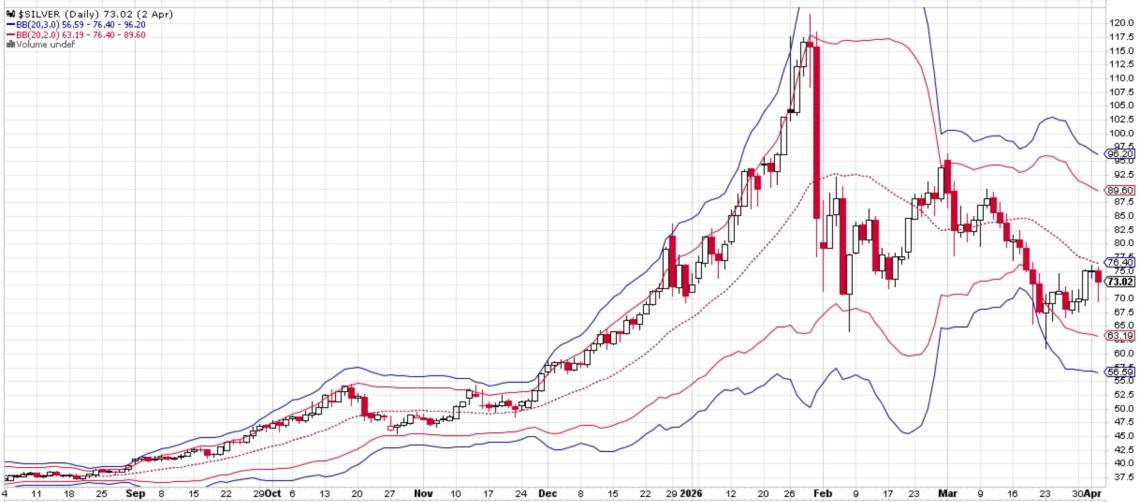
Given the once-in-a-generation move, we fared quite well. I won't say it was painless. It's been stressful trying to navigate the precious metals, but we locked in considerable gains in late January and were able to buy back in at much lower prices in March. I'm not certain precious metals are out of the woods just yet- but they did experience an impressive capitulation event in March and immediately bounced higher. For the time being, I think the metals represent a strong risk/reward opportunity.
Moving Forward
Obviously, the War in Iran is having an incredible impact on all markets, both capital markets and real-world physical markets. We are all feeling the impact each and every day. But there are some other developments that are not currently front-page news that I think could cause some tectonic shifts in the capital markets. And I want to cover them as well. One of those developments is the inevitable collapse of Private Credit. The second is the fracturing of the paper derivatives market. Both of these require additional research before I report on them. So I am going to forego, for now, this section of my update and I hope to have some solid research converted to succinct ideas for you later this week.
Conclusion
It's obvious that the capital markets are becoming more volatile as the world around us becomes more volatile. We are seeing valuations at all-time highs and overnight volatility at all-time highs. This is a challenging market, one in which fundamentals are being overwhelmed with an endless flow of liqudity from the FED. I would be lying to you if I could reasonably discern all that is going on in and around the capital markets. So it is in times like these that a disciplined approach to risk-management provides a much needed sense of security. I can't imagine living day-to-day in these market conditions without the use to stop-loss orders, correlation studies and the other means we use to manage risk. While we saw a decline this month, our risk-management tools have kept us in the black YTD and served us very well.
I'll continue to be hyper-vigilant in managing risk and taking on new positions when the reprent a favorable risk/reward opportunity. As always, please don't hesitate to call us at 512-553-5151 if we can be of any assistance.
Best,
Matt McCracken
1) Inception date of 4/30/2019
2) All benchmark prices and returns are obtained through IBKR's PortfolioAnalyst reporting tool. S&P 500 Index is calculated using the index price. AOM is the iShares Core 40/60 Moderate Allocation ETF. AOR is the iShares Core 60/40 Balanced Allocation ETF. These benchmarks were chosen as they represent the prevailing investment strategies of retail advisors.
3) The Sortino ratio is a commonly used measure of "alpha" or the value a manager adds to a portfolio. It is similar to the Sharpe ratio. The Sortino ratio does emphasize the negative impact of downside volatility more than the Sharpe ratio which is why we use it as our primary measure of alpha.