

Performance Report: 05/29/2026
All performance data for our strategies is net of all fees and expenses. All performance data for indexes or other securities is from sources we believe to be reliable. All data is as of 05/29/2026
Investment Strategy
MAP - Full ($500k+)
MAP - Plus
MAP - Balanced
S&P 500 Index2
Mod Alloc(AOM)2
Growth Alloc (AOR)2
MAR Return
(0.3%)
(1.1%)
(0.7%)
5.1%
2.0%
2.8%
YTD
17.2%
14.0%
5.7%
10.7%
5.2%
7.6%
Inception1
132.2%
N/A
N/A
157.6%
55.5%
80.7%
Sortino3
1.37
N/A
N/A
0.89
0.60
0.74
(Disclosure: We added performance figures for our new strategies solely on a month-to-month and YTD basis as any prior data will be inconsistent and potentially misleading. We will post continuous data for our full-size MAP Strategy since its inception on 5/1/2019. We use AOM and AOR as our benchmarks as they are low-cost index funds that model the exposure of the majority of retail investors. Our risk measures are aligned closely with these funds. It is important to note that individual account performance varies and your account may perform better or worse than its model. The model's performance is simply the average performance of all accounts participating in the model.)
Performance Update
Bank of America just reported yesterday the stock market did something it has only done one other time, which was at the tippy top of the dot.com bubble.
The Stock Market just did something eerily similar to the dot-com bubble top in 2000
Only 20 of the 500 stocks in the S&P 500 made new highs yesterday despite the index charging to new all-time highs. During past peaks in the S&P at least 25% of stocks would be at new all-time highs. Yesterday, it was just 4%. Just very little rotation has been taking place in the past month, which has been detrimental to our strategy. My MAP system is designed to catch "rotations" in the stock market by "buying low and selling high". In a normally functioning market, investors are busily taking profits (selling high) and buying value where they see it (buying low). The MAP system is designed to piggyback on these moves. But since the stock market bottomed a couple of months ago, there hasn't been much in the way of rotation. The stocks with positive momentum kept going higher while the majority of stocks have languished. Thus the MAP has failed to provide too many profitable entries.
A second recent development has also served to be antagonistic to our strategy. Typically, correlations between asset classes and securities are slow to change. Investors like to lock in on certain relationships between investments and cognitive dissonance takes hold. However, over the past few months, correlations across securities have been reversing themselves at a breakneck pace. This has made it nearly impossible to create a low-risk, "all-weather" portfolio.
The unique behavior of the stock market over the past few months has tested my approach to investing. Our performance YTD is still exceptionally good. While the last three months have been flat, our returns over time have bested our benchmarks by a signficant margin.
Looking back at past V-recoveries, like the one currently taking place, I've one a good job of protecting the downside while eventually beating the benchmarks for the balance of the year. After the Covid Crash, we were largely sideways for four months and then I was able to deliver double-digit gains in the back half of the year. After the Tariff Tantrum last year, my strategy was sideways for a couple of months before we ripped off a record-breaking stretch where my Core MAP strategy appreciated over 40% in nine months.
Moving Forward
I have omitted this section of our update for the past couple of months, as it has taken me time to collect data and formulate a strategy. I've finally put together a concise set of points to explain how we will move forward. In past updates, I've been bearish or cautious about the stock market. And that pessimism served us well until about 8 weeks ago. Since then, the stock market has been on a vertical trajectory. I want to cover several outstanding reasons why I'm so pessimistic about the stock market and yet, one single resounding reason why we should stay invested in the stock market.
This section is going to be long and controversial. I want to make it clear that if our views on the market differ in a meaningful way, please bring it to our attention. I don't have a monopoly on stock market insight and we can adjust any individual's portfolio according to their own outlook.
Since 1900, there have been 7 “shocks” to the US capital markets. During each of these shocks, stocks fell in a devastating manner, with 6 of the 7 seeing stocks fall at least 50%. In each instance, distinct factors precipitated the shocks. Four specific variables directly led to each shock. In only one case, 1929, were all 4 variables present, until today. Here are the variables:
- Record-breaking valuations (Stock market is obscenely expensive)
- Above trend inflation
- Physical markets breaking paper markets
- Shadow banking collapse
Here is a table that outlines which variables were in place prior to each shock:
Bear Market
1907
1929
1937
1973
1987
2001
2008
2026
Record Valuations
Yes
Yes
Yes
Inflation > Trend
Yes
Yes
Yes
Yes
Yes
Yes
Physical > Paper
Yes
Yes
Yes
Yes
Yes
Shadow Banking Stress
Yes
Yes
Yes
Yes
Yes
RECORD-BREAKING VALUATIONS:
Only twice in US stock market history has an investor paid such an egregiously large premium for the privilege of owning stocks. Those two moments in time were 1929 and 1999. In both cases, the stock market declined for the subsequent 10 years. Granted, the sample size is small. But a host of investors have made the case that there is a strong negative correlation between a stock market's multiple and future returns.
The most common means of measuring stock market valuations is the Price-to-earnings ratio, or P/E ratio for short. There are several others but they all relay the same message. When stocks are cheap, future returns are above average but when stocks are expensive, returns are below average. And right now, stocks are very, very expensive.
I like to think of the stock market like buying a rental property. Say someone buys a rental property for $100,000, it rents for $1000/month and the cost of ownership is $2,000/year. In this case, the return on investment is 10% (10k/year). If someone pays $200,000 for the same property with the same rent and expenses, the return on investment falls to 5%. And if someone pays $500,000 for the home, then the return on investment drops to 1%. Today, buying the stock market would be akin to paying about $450,000 for that rental home. The only way a person will make money is if they find a greater fool to pay even more.
In October of 2024, Goldman Sachs published a notorious report stating the S&P 500 would likely only return 3% annually for the next 10 years. This was based on the egregiously rich valuation of the S&P 500 at the time. Given a 1% dividend yield, the 2034 target for the S&P 500 would be 7070, a level the index blew through just this past month. Thus, if the Goldman Sach's report is correct, the S&P 500 should produce negative returns over the next 8+ years.
Based on the valuation metric alone, we should be running away as fast as we can from stocks right now.
INFLATION ABOVE TREND
I don't have to tell you that inflation is higher than usual. Throughout stock market history, inflation has proven itself to be quite a bugaboo. Never before has the stock market performed well when inflation was above trend. At least not until today.
In 1907, the Industrial Revolution, coupled with a terrible earthquake in San Francisco, caused copper prices as well as other metals to spike. An attempt to corner copper ultimately caused the Panic of 1907.
Then in the Roaring 20's, the US Government developed a scheme to keep grain prices elevated, causing above-trend inflation in the latter part of the decade. When grain prices finally collapsed, it helped contribute to the '29 Crash. Then the inflationary buildup to WWII led to the fastest 50% correction in US Stock Market history in 1937. The second time in a single decade, the stock market fell over 50%, both influenced by the above trend of inflation.
Some of us may remember the 1970's. (Personally, one of my first memories as a kid is getting to "drive" our Buick Riviera in the gas line while dad pushed it.) The '70's were a decade of above-average inflation and below-average stock market returns. After Nixon defaulted on the gold standard in 1970, the devaluation of the US currency first impacted energy and eventually every corner of the hard asset investment space. The stock market provided an average return of about 4% annually, far in negative real return territory.
Inflation played a significant role in the 2008 Financial Crisis. In addition to real estate inflation, between 2000 and 2008, oil prices increased 10x, gold prices appreciated 4x, the grains popped 5x, and copper and other industrial metals shot up over 6x. Price inflation across hard assets forced the FED to raise interest rates which served to pop the real estate bubble resulting in the harshest financial crisis since the Great Depression.
Today, the stock market has shaken off the inflation threat but inflation remains stubborn. Interest rates have compensated. Initially, the stock market tanked, but it quickly recovered. Why this time has the stock market been able to shake off high inflation and high interest rates in the current environment, and yet it's never been able to accomplish such a feat before? I'll answer that question further down in my update.
PHYSICAL MARKET BREAKING THE PAPER MARKET
In 2023, I wrote a lengthy thesis on this topic, which I’m more than happy to provide to any of my clients who are interested. I’ll do my best to provide the “Reader’s Digest version” here:
- Point #1: Throughout history, capital markets have used “paper derivative contracts” to manipulate capital markets.
- Point #2: Eventually, the physical market overwhelms the paper market, and catastrophe ensues. There has not been a single exception.
1929: The “Whatever is good for America’s Heartland is good for America” thesis in DC led the FED to artificially support grain prices. This led to a rush into farming and a gross oversupply of wheat and other grains by the late 1920’s. The collapse of wheat prices contributed to the 1929 Stock Market Crash.
1970’s Stagflation: To pay for the Korea and Vietnam Wars, the US FED printed more money they had gold to back it. In the mid-part of the 1960’s, a few countries banded together to create the London Gold Pool with the explicit intent to suppress gold prices. France was one of these countries and, as an insider, they were fully aware of the hoax that the US Gold Standard had devolved into. France abandoned the group and subsequently sent battleships to the US to collect their physical gold in exchange for paper US dollars. Nixon was forced to abandon the gold standard resulting in a collapse of the US dollar’s relative value. Inflation soared for a decade and a half. This is likely the most famous example of a paper market being crushed by a physical market but its far from the only example. It has happened time and time again.
2008: The most recent example of the paper market failing was the mortgage-backed securities that failed when the physical prices for homes collapsed. Most all of us remember these dire times which led to the worst recession since the Great Depression. The best study on this series of events is the work by Michael Lewis titled "The Big Short". His telling of what happened when the physical market for homes crushed the paper market for mortgage bonds is excellent, concise and easy to read. And this is one case where the "movie is actually as good as the book."
Since May of 2011, the FED and its member banks (read: Wall Street) have engaged in a scheme to deliberately suppress commodity prices after the onset of Quantitative Easing. In the 6 months following the announcement of QE, several commodities experienced vertical price moves. The FED needed QE to resuscitate the banks but they needed inflation to be tamed to do QE. So the FED and Wall Street started supressing commodity prices, thus inflation, by short-selling hard assets in the paper markets.
Over the past 15 years, this scheme has led to malinvestment in the hard asset space which will invariably lead to stress in the physical market. When the physical market for hard assets overpowers the paper market, the paper market will collapse, taking Wall Street bankers with it. The liquidity crisis that will take place at that time will likely be similar to the liquidity crises of the past (i.e., 1907, 1929 & 2008).
Just in the past few months, there has been a known physical shortage in the silver market. Its likely there will be shortages in some distillate energy products, the rumor now is jet fuel is the most likely victim. It could be elsewhere as well if countries like Brazil decide to quit selling sugar to the US. Eventually, a hard asset shortage will cause a short-covering rally like we haven't seen in many years. But it hasn't happened yet...
SHADOW BANKING COLLAPSE
Throughout history, capital market participants have engaged in “Shadow Banking”. Shadow Banking is simply the act of investors who are not regulated as bankers acting as bankers. And everytime its been tried, it fails. And because it always fails, the market has to keep coming up with new names for the same thing. Wall Street's specialty is obfuscation and nowhere are they more proficient at it than in Shadow Banking.
In 1907, the shadow bankers were called “Thrifts”. In 1929, it was called the “call loan market”. In 1987, it was the Savings and Loan industry. In 2007, it was the Collateralized Debt Obligation market (CDOs) and its nasty cousin, the Synthetic CDO market. (In 1934, a law called the Glass-Steagall Act was passed that largely prevented Shadow Banking and helped prevent contagion when the S&L Crisis took place. In 1999, the Glass-Steagall Acts were overturned and the stock market promptly crashed!)
Today, Shadow Banking is called “Private Credit”. It is the act of investors playing banker who have no right to play banker. It could be as simple as me lending money to you. But on a larger scale, it is a hedge fund loaning money to a company that can’t get a bank to approve a loan. It’s a group of investors engaging in “hard money loans” to a spec home builder.
AND PRIVATE CREDIT IS COLLAPSING. We are in the early innings of the collapse. But it is happening. Just a couple of months ago, several private credit funds restricted redemptions, which has two meanings. First, the smart money is moving out of the space trying to get their money back. Second, the Private Credit funds don’t have the money to give. In a well-functioning market, either new buyers would step up to purchase the shares and/or the funds would be able to meet redemption requirements. But that is not happening.
By the end of the decade, I can promise that the collapse of Private Credit will go down just like the Thrifts did in 1907, the S&L's did in 1987 and the CDO issuers did in 2007. But perhaps it won't happen until 2027!
THE GIGANTIC ASTRICSK: QE
So, if the outlook for stocks is terribly dire, why still be invested? What's different this time that has pushed every possible metric to the absolute extreme? The answer: QE
In November of 2010, the FED announced they would engage in Quantitative Easing (QE). What is QE? The technical definition is involved but in layman's terms, it means “money for nothing”. QE gives the FED the right to print as much money as they want, whenever they want, and no one can stop them. Prior to November of 2010, there were restrictive guardrails on what the FED could and couldn’t do. Those guardrails were removed 15 and half years ago. And ever since, any economic obstacle has been met with a bazooka of new, fresh cash.
In 2020, during the height of the COVID pandemic, the FED printed $5T overnight. Let’s put this in perspective. From 1917 until March of 2020, a span of 103 years, the FED has created $25T dollars. In a single day, they printed 20% of the money that they had created over a 100-year span.
The “genius” idea of QE was popularlized by former Fed Chairman "Helicopter" Ben Bernanke. Following the 2008 Financial Crisis, he stated that “deflation was in impossibility” as the FED could literally drop money from a helicopter and defeat any deflationary forces. He would go on to say that the helicopter wasn’t even necessary, as the FED could do the same thing with a simple click of a button on a mouse.
Here is a chart of the money supply
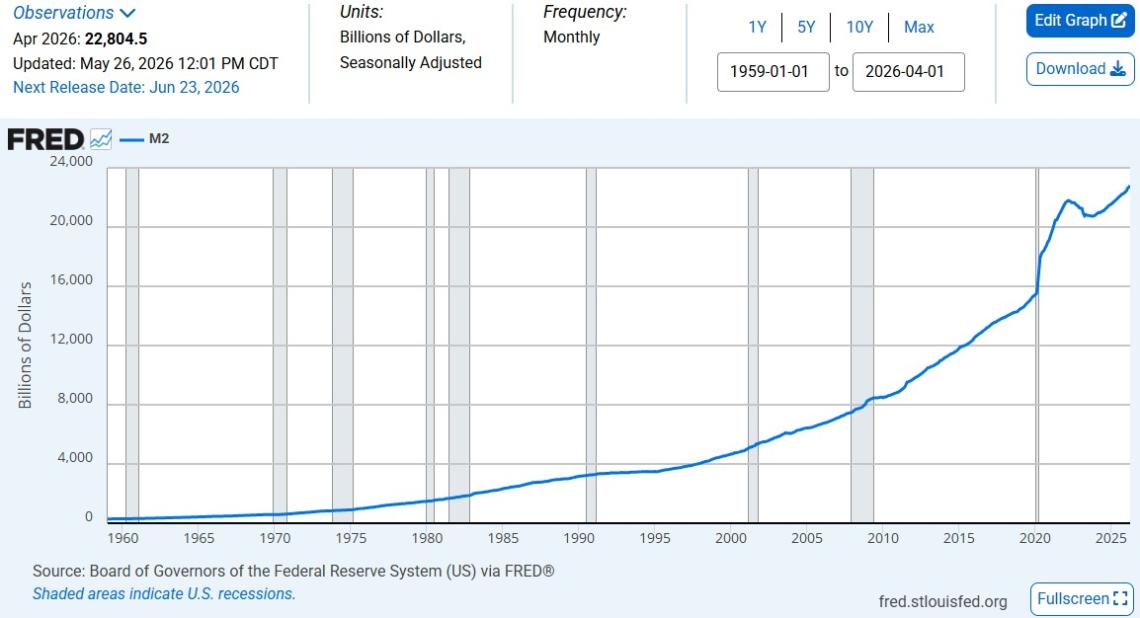
Now, where is all this money going? Did you get a check? I didn’t get a check. No helicopter flew over the Texas Hill Country “making it rain Benjamins”. Had that happened, inflation would have run rampant. So the FED has figured out a far better way of deploying the money, at least for them and their Wall Street masters. They inject the money straight into the capital markets via large Wall Street banks. The FED is the engine and the Wall Street banks are the transmission mechanism.
So the stock market will keep going up and up and up...until a couple of different things happen.
- Hard Asset Shortages: If there is a hard asset shortage (i.e. silver, oil or sugar), the Wall Street banks will have to cover their positions by delivering physical assets that they have no means of delivering. It will create the largest short squeeze in human history. How the FED will try to unwind it, I can't even guess. But once that happens, Wall Street will no longer be able to short paper futures contracts to suppress hard asset prices. Then the gig is up.
- Fragmented Credit Market collapse: Can the FED salvage a fragmented debt market? They have had success in resuscitating a homogeneous debt market, such as mortgages and, more recently, the US Treasury market. But can they salvage private credit and I'll throw in munipal bonds in as well. The muni bond market is about as fragmented as any.
HOW DO WE MOVE FORWARD:
I have developed a three prong strategy to protect our gains while continuing to grow assets. If the FED fails, the stock market will undergo extreme stress. And periods of extreme stress can be wonderfully profitable if invested in appropriately. Sir John Templeton and John Maynard Keynes made their fortune during the 1930's. Warren Buffett and Jim Roger's best years were in the 1970's. When markets tank, opportunities abound.
1) Add low-priced stocks: Since the inception of my MAP strategy, we've had a great deal of success buying low-priced stocks. MP last year below $20, UEC and UUUU trading at a $0 handle in 2019 are just a couple of more outstanding examples. These positions have made significant contributions to our returns. I've spent the past few weeks researching affordable stocks, and if you open your account, you'll see some small, low-priced stocks that I've added the past couple of weeks. We've already seen a nice bump in a couple of them. I'm looking for more and will continue to add them to my MAP system.
2) Continue to apply our strict risk-management procedures: I will say I have had to tweak our approach to applying stop-limit orders on all our positions. Once the US military took decisive actions against Iran, the overnight activity in capital markets went ballistic. Several of our stops were blown out overnight. At IBKR, we can engage in overnight trading, but it is not ideal, and even then, we may not get our price. So, I've increased the tolerance bands for our stops. This will hamper returns when the positions appreciate, but at this juncture, I'm more concerned with safe, modest gains than I am with risky, outsized gains. I'm also focusing on using non-correlated securities as much as possible. The past few months have challenged me in this regard, but we've come out stronger on the other end.
3) Buy securities that will benefit from the BIG SQUEEZE: Whether we get a once-in-a-lifetime short squeeze in hard assets or a liquidity squeeze in debt instruments, I'm proactively investing in securities that should benefit. In the interim, these securities are likely to be a drag on performance but I am confident they'll do very well if, and it is a big IF, there is a BIG SQUEEZE EVENT.
Conclusion
My gut kept telling me that the stock market would require one more blow-off top before peaking. I believe we are now in that phase. Above, I quoted an article from CNBC explaining the abysmal participation of this rally, as only 4% of all stocks seem to be actively participating. What could be even more telling is how the story was immediately taken off of CNBC's homepage within an hour and scrubbed from the search engines. You can find the story on other sites now but you can no longer search for it on CNBC.
All the textbook signals of a market peak are in place. Again, never before has a stock market been supported by QE so stocks could continue higher. But I will be vigilant in limiting losses while also eager to lock in gains.
As I've stated in the past few updates, I'm now concerned with protecting gains rather than generating them. But I'm not conceding. I'm continuing to work diligently to find new opportunities. If the hard asset squeeze does happen, I'm pretty confident we'll see some big gains. But until then, I'm being cautious and I expect either gains or losses to be modest.
As always, please don't hesitate to call us at 512-553-5151 if we can be of any assistance.
Best,
Matt McCracken
1) Inception date of 4/30/2019
2) All benchmark prices and returns are obtained through IBKR's PortfolioAnalyst reporting tool. S&P 500 Index is calculated using the index price. AOM is the iShares Core 40/60 Moderate Allocation ETF. AOR is the iShares Core 60/40 Balanced Allocation ETF. These benchmarks were chosen as they represent the prevailing investment strategies of retail advisors.
3) The Sortino ratio is a commonly used measure of "alpha" or the value a manager adds to a portfolio. It is similar to the Sharpe ratio. The Sortino ratio does emphasize the negative impact of downside volatility more than the Sharpe ratio which is why we use it as our primary measure of alpha.